Wednesday, March 26, 2014

Hashtag Chiberia

Dining room ceilings across Chicago protest the
Narnian winter.
First it looked like this.

Frustrating. Water drip, drip, dripping through bubbling paint on the dining room ceiling.

I poked holes in the puffed out layer of paint, and yellow water streamed out. We positioned buckets under the leaks, and pressed on the separated paint layers to push the remaining water out.

But releasing the water did not solve the problem, and a few days later, we heard a loud PHHHHHLLLUUMMMPHHHHH. Mr. Peevie and I ran out to the dining room to see layers of plaster and insulation coating the table and floor. 

It was quite impressive. For a little while the hole looked like this: 


But Mr. Peevie kept looking at that uncollapsed corner and saying, "I think this is gonna go, too. Stay away from this corner, guys. It's gonna go." 

I admit I made fun of him for his pessimism--and then about a half hour later--PHHHHHLLLUUMMMPHHHHH! Down it came. Sometimes pessimism is another word for "I told you so."

Fortunately, Mr. Peevie did not listen to my Pollyanna outlook, and he had prepped for the second collapse by putting down tarps and bins, which caught a lot of the debris. We have made the first-ever claim against our homeowners' insurance policy since we bought our first house about twenty years ago.

We went through a similar experience with the water dripping through the dining room ceiling five years ago-- And guess what?

The last time Chicago recorded a high temperature below zero was Jan. 15, 2009 -- exactly five years ago. 

"The bitter temperatures follow several days of snowfall," the article reports. Almost twelve inches of snow fell at O'Hare that week--and almost nine of them in one day, breaking the record from 2005.

Apparently, this phenomenon is caused by ice dams that form on the edge of the roof, forcing melting snow back under the shingles, where it creeps in and leaks out inside the house. And it's not just happening at the Peevie homestead, either. It's happening all over Chiberia.

Five years ago, though, the winter was less Narnian than this interminable, tenacious, entrenched season that continues to break records. When I started writing this post, we had marked 75.5 inches of snow so far this season. then later that day we received another batch. To date, our snowfall totals have exceeded 80 inches--80.6 to be exact-- which obliterates the '69-'70 record (77 inches) and wags a warning finger at the '77-'78 second place record (82.3 inches).

I don't think we're going to hit the all-time snowfall record of 89.7 inches in 1978-79, which is a little bit sad since we've come so far. All we'd need would be another 9.2 inches of snow. 

Come on, snow gods! Sock it to us! Let's crush that record!

(BTW, in light of my previous post, the source for these snowy stats is the NBC-5 weather blog.)

Tuesday, March 4, 2014

Cite Your Source

My kids learned at an early age that they couldn't convince me of anything just by saying it.

"Cite your source," I'd say.

One time, when Aidan was about ten or eleven, he told me I should stop buying gas at certain gas stations because the company owners hated America. At the time, he attended a tiny conservative Christian school where the popular consensus was that Obama was a socialist fascist dictator, born in Kenya and bent upon destroying the American Way of Life. Some folks were quick to jump on any McCarthy-esque rumor that popped up on the internet.

The inherent socio-political contradictions of that assertion aside, I wanted to teach my kids to respect other people's views, but also to think for themselves by looking at them with a critical eye. 

"Don't believe it just because someone says it's true," I would say.

So, when he told me about the gas station, I asked him to cite his source.

"Ringo's mom," he said confidently.

"She's a secondary source," I said, and then I explained to him the difference between primary and secondary sources. This explanation involved me defending myself against the charge that I thought Ringo's mom was a liar. 
Paul Reiser and Helen Hunt in
Mad about You; photo from TV.msn.com

"What source was Ringo's mom citing?"

"She read an article," he said.

Ah-hah. The definitive, indestructible "she read an article" defense.

(Mr. Peevie and I watched a show in the 90s called Mad About You with Helen Hunt and Paul Reiser. We still quote one of those episodes, in which Helen Hunt's character Jamie argues with her husband Paul, and he asks her how she knows what she's claiming. "I read an article!" she says--and it becomes a recurring theme. I squandered an hour watching Mad About You clips to try to find this scene, to no avail. This is how seriously I take my Green Room duty. You're welcome.)

As it turns out, the politics of gasoline are far more complicated than a simplistic anti-America rumor would have it. Snopes breaks it down. Notice the list of sources at the bottom of the article.

Sometimes, even sources that appear on the surface to be legitimate lack scientific rigor and should be source-checked.. See, for example, this article on the dangers of vaccinations from a secondary source called The Free Thinker (which looks like the Libertarian version of Huffington Post),written by a dude named Dave Mihalovic.

It all comes down to science and math: does the article cite (and more importantly, link to) legitimate scientific sources? The vaccine article referenced above makes many claims, none of which are sourced. The author cites "secret" CDC documents--but doesn't link to them or provide screen shots. There's no way for a thinking person to double check his claims--we're just supposed to believe him.

Um, no.

The first link in the article is to an article in another secondary source with equally shady credentials--not to an FDA document or a CDC memo or a news story, but to another article by the same guy. "Here," Dave Mihalovic is essentially saying, "you can trust me, because I said it again over here in this other article." Please.

In the third paragraph, the article quotes Brian Hooker, "a PhD scientist" about a CDC cover-up of the alleged risks of vaccinations. Who is Brian Hooker? What are his credentials in medicine, and medical research? What replicated studies has he conducted, and with what legitimate scientific controls?

The answers are, in order: He is a biochemical engineer who works as a consultant in the biotech industry.  He has no medical credentials, and has done no studies, that I can find. He's just a guy who is motivated, sadly, by the alleged vaccine-caused autism of his own child.

Regarding the claims in this article that the CDC has covered up data from their own Vaccine Safety Datalink database showing a "very high link between Thimerosal-containing vaccines and autism rates in children": Show me the proof, dude.

The article claims that there are "a number" of public records that back up this claim--but only links to a 20-page Congressional Record from ten years ago. This document actually contradicts the authors claims: "...exposure to less than the minimal risk level is believed to be safe" and "the minimal risk level would need to be multiplied by ten to reach a level at which harm would be expected through exposure." You can find this out for yourself by clicking the link, and then control-F searching for the word "risk" and looking at the 18th occurrence of the word. See? I have done all the work for you.

You're welcome.

Whatever. This is just one example of millions, and just one topic of dozens that we encounter every day in the news, on Facebook, or in casual conversation, which requests our uncritical acceptance of a questionable assertion. 

Don't do it. Be a critical, questioning listener--not just about gas stations and vaccinations, but about everything--things that cause cancer, things that prevent heart attacks, things that pastors say, things that politicians say--and not just the ones you disagree with. You get the picture.

Or, alternately, you could just trust the opinions here at The Green Room, and I promise, we will always provide primary sources.

Sunday, January 5, 2014

Stop Saying This Word

I'm going to tell you why you should stop saying the word "should." And yes, I hear the irony.

Sometimes--especially around this time of year--we say that word to ourselves: I should lose weight. I should exercise more. I should read more books. I should drink less wine. I should be less crabby with my kids. I should call my mom more often. I should stop being a bad Christian.

We should all stop saying should to ourselves. I am trying to stop "shoulding" all over myself--but more about this in my upcoming memoir. (Props to my therapist, Doc, for that  nearly homophonic pun.) But this post specifically addresses the use of the word should when it's directed at another person.

Stop saying "You should..." to other people. It comes under the heading "Unsolicited Advice: Never Give it."

Don't tell your sister who has stage three ovarian cancer that she should feel grateful that she doesn't have stage four ovarian cancer. This is an important sub-category of Stop Saying Should: Don't tell any cancer patient--or any person with any illness at all--that they should feel grateful. In fact, just stop telling people how to feel.

Don't tell your overweight friend that she should try yoga or pilates or aqua cycling or pole dancing classes.

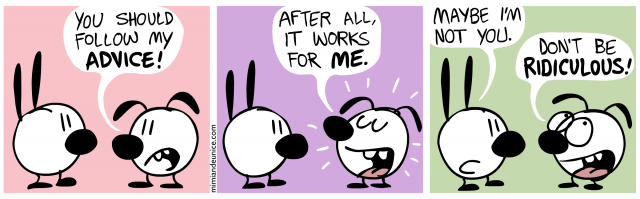
you should follow my advice / after all it works for me / maybe i'm not you. don't be rediculous
Thanks to Mimi and Eunice for the cartoon.
Don't tell parents who are dealing with a child that JUST WON'T SLEEP, "Oh, you should try Dr. Sleep Nazi. I did, and now my kids sleep perfectly!" 

Don't tell your son or daughter or friend or neighbor that they should spank their temper-tantrumming child, or that they should not give their children candy, or let them watch TV or play video games. Don't ever use the word "should" to your parenting son or daughter with regard to their parenting choices.

I know that your intentions are good. I know that you are only trying to be helpful. I understand that in your mind, when you offer an unsolicited "you should...", you are offering the benefit of your wisdom and years of experience.

But here's how it comes across: You know better than me. You would feel differently if you were in my shoes. You are better than me, and you would make different choices. It's easy if only I'd do it your way. You are trying to fix me.

Do you hear the condescension? That's how it feels. It's not helpful or constructive--in fact, it's counterproductive.

All of this is, of course, moot if your friend/son/daughter is actually asking you for advice. Then it's OK to make suggestions--although This Blog still recommends that you do it without using the phrase "you should." Try these alternatives: "Have you tried..."; "What worked for me was..."; or "I wonder if you could..." These phrases have a degree of humility and compassion.

By the way, I should people all the time. It's an instinctive reaction, I think--when we see someone we care about struggling, we want to help, to fix, to advise. One time I told my friend Roseanne, who was struggling with money issues, "You should cancel your cable subscription." To this day, I hear myself saying that, and I cringe. Who the hell am I to tell her how to live her life and balance her checkbook? None of us know enough about another person to tell her what she should or should not spend her money on--UNLESS SHE ASKS US FOR ADVICE.

What unsolicited shoulds have you received lately? And have you dished any out?

Wednesday, January 1, 2014

Letting Go and Holding on Tight

One thing defines 2013 for me: the loss of Aidan. He died in 2012, but we spent 2013 trying to learn how to live our Aidan-less lives.

I still have days, like Sunday a week ago, when I cry so hard and for so long that I'm exhausted and ready to go back to bed by 2 p.m. But then days go by when I only cry a little bit, like today. I shed a few tears when I write about him; or when I see something Aidan-esque, such as a manatee, a toy train, or a Pokemon; or when I walk past the table that holds photos, cards, and mementos. Mr. Peevie has moments, hours, and days like this, too.

Seattle
I think this is what getting through grief looks like. Midway through the year I said to the therapist, I don't know how to do this, how to walk through this dark valley. He said, "You're doing it." I suppose what he meant was that I was getting out of bed, working, taking care of my family--sometimes badly, and always with the constant presence of Aidan's absence, but I was doing it.

We took a family vacation to Seattle in late June. We had a fabulous trip--as as perfect as it could be without Aidan. Everything is measured by that yardstick, now; everything is viewed through the lens of not having Aidan. Our photographs have two kids in them, instead of three. We asked for a table for four at dinner; we purchased four bus tickets; four people divide easily between two beds. 

Two kids rolling down a hill instead of three.
In August we attended the wedding of friends whom Aidan loved, and who loved Aidan. I started to cry from the moment the groom looked down the aisle at his bride as her father walked her to the front of the church. I cried for Aidan and for our lost future; I cried because Aidan did not get to see his friends' beautiful ceremony, because he won't have his own, or stand next to C. Peevie and M. Peevie at theirs.

I had lunch with a friend later that month, and our conversation covered many topics--but later she said she felt that every conversation should be about Aidan and about our loss, about our missing him. This notion felt exactly right to me. For a long time nothing else mattered except that Aidan was gone.
I think this is at the Space Needle.
His loss was a bleeding, internal wound that would never heal. It was chronic and debilitating. 

There are still times that nothing else matters except that Aidan is not here. Bereavement obstructs my work, my relationships, even my faith. In church, there are still times when I cannot worship, pray, confess, commune, or greet because all I can be and feel is that I have lost Aidan-- which feels incompatible with worship, and especially with confession. I can look at Jesus, but only as a sufferer, not as a sinner. It's like I exist on two different planes, or in two different dimensions; or I'm schizophrenic. If one personality has surfaced, the other recedes. 


But one year, one month and twenty-one days later, I can see that my grieving has changed from what it used to be, when it consumed most of my waking hours. It is still a constant presence, but it is no longer constantly debilitating. Bereavement has changed me--it has changed all of us--but this new, bereaved me is slowly re-learning how to do relationships, work, and worship all over again.

Part of me feels that this reduction in debilitation is a betrayal of Aidan, like I don't love him enough to keep on suffering the most intense and painful grief. But if I let myself go down that rabbit-hole of despair, I would spend the rest of my life not just grieving, but clinically depressed and possibly suicidal. So I remind myself that moving through grief and letting go of the empty despair of those first few weeks and months is the right thing to do for myself, my family, and for Aidan's memory.
Aidan and Mr. Peevie in Colorado, 2011.


Continuing to let go of debilitating grief, but holding on tight to Aidan, to my memories of him, to the things he loved and valued, and to the lessons he taught me--this is where I hope 2014 will take me. 

But god, I miss that kid.

Tuesday, December 31, 2013

The Traveling Sketchbook, or Serendipity


The Girlfriends gather once a year in South Haven for a weekend of getting-away-from-it-all which includes laughs, adult beverages, and a white elephant gift exchange. We enjoyed this annual event so much this year in January that we decided to make it a semi-annual event and do it again in September. 

We opened white elephant gifts while wearing fake facial hair, which made every gift and every conversation exponentially more hilarious. The gift exchange produced a collapsible, portable camping toilet; an awful "get-in-touch-with-your-feelings" card game from the 1950s, targeted to socially-challenged adolescents; and a sexy black lace dress with plunging neckline, which the recipient modeled. We photographed her and immediately sent the image to the husband in question. 

 
The most interesting gift of the night was an old sketchbook that Girlfriend Y-Tee had found decades earlier in an alternative school on Chicago's north side. No one claimed them or knew where they had come from, so she called dibs and brought them home. They had been sitting in a storage box in her basement for thirty years--and now one of them became part of Girlfriend Tradition. We wondered about the artist, and whether his career had taken an artistic trajectory.


"Let's try to find him!" we agreed, and I whipped out the trusty Internet. The name on the front cover of the sketchbook was David Enblom, so I googled "David Enblom artist." I got almost 40,000 results--but the first page of links was all our guy. The link led us to a website called MNArtists.org, and Mr. Enblom's homepage on that site listed his own website, which we quickly checked out. 

Mr. Enblom, it turns out, is a talented photographer, although his website was designed for minimum aesthetic appeal and maximum randomness. His landing page includes links to his photographs, his Facebook page, Beatles songs and lyrics, and a playable list of the Billboard #1 Pop Hits from 1941 to 1976. Glen Miller's Song of the Volga Boatmen is playing in the background at this very moment. 

I took photos of several sketches, attached them to an email, wrote "Found these in a sketchbook with your name on it. Are they yours?", and hit send. Thirteen hours later, Mr. Enblom replied enthusiastically, "Yes they are! Would love to see more!" 
 So we sent four more images, and told him that our friend had found his sketchbooks in an alternative high school in Chicago in the '80s. This launched a dialogue with Mr. Enblom, who thought his mom had tossed all of the sketchbooks in the trash. He asked to "borrow" them so he could copy the images, but G.YT was happy to reunite them with their creator. Mr. Enblom--can I call him David? I feel like he's practically one of the girlfriends by now--David lives in St. Paul, Minnesota, and has never lived in Chicago; so how did his sketchbooks end up in a north side high school? David started filling sketchbooks when he was in his early 20s, in 1971. He had switched from studying pre-med to art; you can see the influence of pre-med in his anatomy drawings. "I fell in love with art," David told me, "Dada, surrealism, fluxus." He believes that his girlfriend at the time brought the books to Chicago. She later married a guy who was involved in starting the Prologue school where the books eventually ended up, and where Y-Tee found them many years later.It was a big thrill, David said, when the sketchbooks arrived in the mail. He had assumed that they had all been thrown out and that he'd never see any of them again. Getting the books back "was like finding out you have a brother that you were separated from. I'm getting to know a part of myself--how many memories do you have from 40 years ago?"Many gifts came out of this little adventure. One of them is that David introduced us to The Sketchbook Project, which is a "global, crowd-sourced art project and interactive traveling exhibition of handmade books." There are already more than 28,000 sketchbooks in the exhibit--and you can join the fun. Order your very own sketchbook here for only $25--or check out the digital library of sketchbooks on the website.

Sunday, December 1, 2013

Reading Les Miserables in Chicago

I finally finished reading Les Miserables (an English translation, obvs) this month--more than three years after I started it.

I had such high hopes when I first ordered the free Kindle version. It's only 959 pages, I thought to myself. I can handle that. After all, I'd already plodded through Victor Hugo's The Hunchback of Notre Dame--all 550 pages--including an entire novel's worth of narrative about the history and architecture of the cathedral; and 750 pages of Herman Melville's Moby Dick--including 30,000 words about whale blubber. That is not a lie.

The difference between the reading of those two novels and the latest novel is that I read with others in a reading group, with a deadline. I read Les Mis on my own, with no time constraints; and during the duration of my reading of I Am Miserables, I read 49 other books (according to my LibraryThing book tags), one of which, Kim, by Rudyard Kipling, was almost as unreadable as I'm Still Miserables

OK, that's a bit harsh. It's just that I'm a simple person, with lofty intentions but with the attention span of a toddler hopped up on Twix at Halloween. So when I encountered the 19-page table of contents (again, not a lie), I thought to myself, "Oh, crap." 

You know you're in trouble when some of the chapter titles are longer than entire chapters of some books. For example: Volume II, Book Second, Chapter II: In Which the Reader Will Peruse Two Verses, Which Are of the Devil's Composition, Possibly, and also Chapter III: The Ankle-Chain Must Have Undergone a Certain Preparatory Manipulation to be Thus Broken With a Blow from a Hammer.

You also know you're in trouble when you don't understand a single word in some of the lengthy chapter titles, as in Volume III, Book Eighth, Chapter XIII: Solus Cum Solo, In Loco Remoto, Non Cogitabuntur Orare. Apparently, they only had a budget for for French-to-English, not Latin-to-English.

Barnes and Noble claims that Les Miserables is the home of the longest sentence ever written, clocking in at 823 words. But the Victor Hugo Internet Hub debunks this risible impertinence, citing five novels with longer sentences. I remember that sentence, however; it caused my undiagnosed aneurysm to throb.

The beautiful thing about reading on the Kindle is that you can look up words you don't know as you go along, without having to stop and pick up your unabridged Oxford English Dictionary. This is fortunate, because Victor Hugo is a vocabulary beast -- I encountered unknown lexical combinations on virtually every page. I am determined to find many opportunities to use recrudescence and fulgurating and matutinal in everyday conversation.

It was disconcerting, however, that many of the words I highlighted did not have definitions in the Kindle dictionary--such as pterigybranche, poignarded, emphyteuses, and arondissement. As it turns out, Hugo's narrator does not hide his linguistic snobbery, and his disdain for anything but the most precise and standard vocabulary and usage. He refers to 


...that abject dialect which is dripping with filth when thus brought to the light, that  
pustulous vocabulary each word of which seems an unclean ring from a monster of the mire and the shadows. Nothing is more lugubrious than the contemplation thus in its nudity, in the broad light of thought, of the horrible swarming of slang. It seems, in fact, to be a sort of horrible beast made for the the night which has just been torn from its cesspool...what is slang, properly speaking? It is the language of wretchedness. 

Awesome.

Victor Hugo's middle name is digression. He admits this in the third sentence, after introducing the character Myriel, Bishop of D--: "Although this detail has no connection whatever with the real substance of what we are about to relate, it will not be superfluous...to mention here the various rumors and remarks which had been in circulation about him..." Hugo then spends the next 63 pages introducing the Bishop, who plays a key role in Jean Valjean's life even though he only appears briefly in the book. The Bishop gives Jean Valjean valuable silver, and urges him to use it to become an honest man; and after this encounter, the Bishop never returns to the story. 

The trick with reading Hugo or any prolix classic author is to figure out which digressions you can skim over without losing track of the main characters and plot lines, and which digressions contain indispensable facts and connections. I failed miserably at this task, which is why it took me three years to finish the book. I probably could have flipped past the entire Volume I, Book Third, or at the very least the first chapter of said Book entitled The Year 1817, which is a single seven-page paragraph name-drop. I could have spurned the entire Book First, Volume II, which comprises 19 chapters (47 pages) about the Battle of Waterloo--which the title of Chapter V refers to as The Quid Obscurum of Battles. (I googled quid obscurum. It means something like what darkness. It's also the name of a famous thoroughbred horse.)

Hugo wrote six chapters about the sewers of Paris in Volume V, Book Second. The Intestine of the Leviathan describes in torturous detail the history, construction, geography, and putrescent contents of the French sewer system. There's some interesting, even quotable, material in there--such as the passage that describes the sewer as "the conscience of the city:"


All the uncleannesses of civilization, once past their use, fall into this trench of truth, where the immense social sliding ends. They are there engulfed, but they display themselves there. This mixture is a confession. There, no more false appearances, no plastering over is possible, filth removes its shirt, absolute denudation puts to the rout all illusions and mirages, there is nothing more except what really exists, presenting the sinister form of that which is coming to an end...All which was formerly rouged, is washed free. The last veil is torn away. A sewer is a cynic. It tells everything.

But if I had neglected this section, it would not have diminished my understanding of the story.

Some of the excursus distracted from the heroic storyline but proved germane to contemporary social and political discussions--such as the analysis of the political stage in France in the early 1830s, described in Volume IV, Book First, Chapters I - IV. These are the kinds of passages that get books banned in the red states:

Solve the two problems, encourage the wealthy,and protect the poor, suppress misery, put an end to the unjust farming out of the feeble by the strong, put a bridle on the iniquitous jealousy of the man who is making his way against the man who has reached the goal, adjust, mathematically and fraternally, salary to labor, mingle gratuitous and compulsory education with the growth of childhood, and make of science the base of manliness, develop minds while keeping arms busy, be at one and the same time a powerful people and a family of happy men, render property democratic, not by abolishing it, but by making it universal, so that every citizen, without exception, may be a proprietor, an easier matter than is generally supposed; in two words, learn how to produce wealth and how to distribute it, and you will have at once moral and material greatness; and you will be worthy to call yourself France.

So. I finished reading Les Miserables. I'm glad I read it, in the same way I'm glad I ran a marathon back in the '80s when I was young, energetic, child-free, and motivated by sibling competition. I have earned my bragging rights, but thankthelittlebabyjesus, I will never have to do it again.

What ridiculous book are you laboring to finish?

Monday, November 11, 2013

One Year Ago Today

One year ago today, Aidan died. 


We had spent the afternoon with Manuel and his wife, Mrs. Manuel. (I wrote about Manuel here.) Manuel rudely moved to North Dakota in June 2012. We all missed him, but Aidan missed him most of all. Manuel and Aidan had a tender friendship: as the youth director at our church, Manuel gave Aidan spiritual insight and support, academic help and encouragement, and loving acceptance. Aidan gave Manuel—what, exactly? I’m not sure, but Manuel described their friendship this way when he gave a remembrance at Aidan’s funeral:

I have found myself treasuring the memory of a young man who quietly defied convention. Though our friendship was brief, I will forever be grateful beyond words that Aidan allowed me to be a part of his beautiful and complex inner world... Our friendship was initially established in the realm of the imagination--his mostly...
I discovered a boy whose favorite hobbies were creativity and imagination. These were not static nouns to him--they were his every waking moment. Dragon lore, reference manuals on mythical monsters, fantasy novels, and poetry all captured Aidan with a sense of wonder. It was a regular sight--Aidan staring off into space, only to whip out a spiral-bound notebook and begin drawing furiously; and then creating action statistics in case this new character made it into the card game he had invented.

I love that he was able to capture Aidan's essence so beautifully.

Two weeks before Aidan died (Aidan died. Will I ever be able to hear or say those words without receiving an emotional concussion?) he had told me several times how much he missed Manuel, wished he could see him, and wondered if he would come back to visit. “I need to talk to Manuel,” he told me at one point. I told him we’d be having lunch with him after church in a few days, and his face lit up. “How long will he be here?” he asked. “Probably for at least a few hours,” I said. “I’m sure he wants to spend time with you.” He smiled his curvy Aidan smile. I don’t remember, but he probably hugged me, because he rarely passed up an opportunity for a hug.

We had lunch together around the kitchen table. We ate corn and wild rice chowder with polish sausage, and crusty Dutch oven artisan bread straight out of the oven. Manuel, a frequent bread baker, was impressed with the simplicity and ease of the Dutch oven recipe.

I want to remember every word of our conversation around that table. I remember that M. Peevie and C. Peevie dominated the conversation, and that Aidan was quiet but happy—but I don’t know if this is a true memory, or just a typical meal-time scenario. Whether he said much or little, I do know for sure that Aidan was happy.

Manuel left, and a half hour later Aidan collapsed, was rushed to the hospital, and was not able to be resuscitated. Manuel and Mrs. Manuel joined us in the ER, along with our pastors and several friends. We sat in shock; our friends surrounded us, and we clung to them. Mrs. Manuel wrapped her arms around M. Peevie. 

"I don't know how to leave this place without him," I said, over and over again. But we left, eventually, and went home to a house filled with neighbors and friends who somehow understood that showing up was the right thing to do. They came, with bleak expressions, offering their tears and embraces. I think 40 or 50 people showed up that night.

I cried a bit in those first few hours, but mostly I felt numb. My tears did not come until four weeks later, even though I desperately wanted to cry. 

In the weeks and months following, we have slowly re-learned how to breathe, how to laugh, how to somehow live our Aidan-less lives.

How often--will it be for always?--how often will the vast emptiness astonish me like a complete novelty and make me say, "I never realized my loss until this moment"? The same leg is cut off time after time.                                                                                    --C.S. Lewis, A Grief Observed


Photo: Missing Aidan. November 11, 2013.