Showing posts with label rant. Show all posts

Sunday, January 5, 2014

Stop Saying This Word

I'm going to tell you why you should stop saying the word "should." And yes, I hear the irony.

Sometimes--especially around this time of year--we say that word to ourselves: I should lose weight. I should exercise more. I should read more books. I should drink less wine. I should be less crabby with my kids. I should call my mom more often. I should stop being a bad Christian.

We should all stop saying should to ourselves. I am trying to stop "shoulding" all over myself--but more about this in my upcoming memoir. (Props to my therapist, Doc, for that  nearly homophonic pun.) But this post specifically addresses the use of the word should when it's directed at another person.

Stop saying "You should..." to other people. It comes under the heading "Unsolicited Advice: Never Give it."

Don't tell your sister who has stage three ovarian cancer that she should feel grateful that she doesn't have stage four ovarian cancer. This is an important sub-category of Stop Saying Should: Don't tell any cancer patient--or any person with any illness at all--that they should feel grateful. In fact, just stop telling people how to feel.

Don't tell your overweight friend that she should try yoga or pilates or aqua cycling or pole dancing classes.
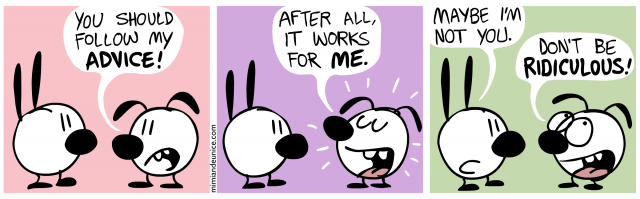
you should follow my advice / after all it works for me / maybe i'm not you. don't be rediculous
Thanks to Mimi and Eunice for the cartoon.
Don't tell parents who are dealing with a child that JUST WON'T SLEEP, "Oh, you should try Dr. Sleep Nazi. I did, and now my kids sleep perfectly!" 

Don't tell your son or daughter or friend or neighbor that they should spank their temper-tantrumming child, or that they should not give their children candy, or let them watch TV or play video games. Don't ever use the word "should" to your parenting son or daughter with regard to their parenting choices.

I know that your intentions are good. I know that you are only trying to be helpful. I understand that in your mind, when you offer an unsolicited "you should...", you are offering the benefit of your wisdom and years of experience.

But here's how it comes across: You know better than me. You would feel differently if you were in my shoes. You are better than me, and you would make different choices. It's easy if only I'd do it your way. You are trying to fix me.

Do you hear the condescension? That's how it feels. It's not helpful or constructive--in fact, it's counterproductive.

All of this is, of course, moot if your friend/son/daughter is actually asking you for advice. Then it's OK to make suggestions--although This Blog still recommends that you do it without using the phrase "you should." Try these alternatives: "Have you tried..."; "What worked for me was..."; or "I wonder if you could..." These phrases have a degree of humility and compassion.

By the way, I should people all the time. It's an instinctive reaction, I think--when we see someone we care about struggling, we want to help, to fix, to advise. One time I told my friend Roseanne, who was struggling with money issues, "You should cancel your cable subscription." To this day, I hear myself saying that, and I cringe. Who the hell am I to tell her how to live her life and balance her checkbook? None of us know enough about another person to tell her what she should or should not spend her money on--UNLESS SHE ASKS US FOR ADVICE.

What unsolicited shoulds have you received lately? And have you dished any out?

Wednesday, June 30, 2010

Three LittleThings That Bug Me

I don't want to sound like a giant crankopotamus here, but certain things bug me.  I'm going to get them off my ample chest here and now, and then I'm going to Choose to be Cheerful again.  K?

1.  I hate getting emails with a subject line that reads "Re:".  Just "Re:".  Re: what?  People:  are you really SO BUSY that you can't take the time to write even ONE WORD to identify the content of the email?  ONE STINKING WORD?

An email without a subject line is like a canned good without a label--open at your own risk. It's also a missed marketing and communications opportunity.  Q:  Are you listening?

2. "Lol" tacked onto the end of texts, FB comments, and emails to show that you have just made a joke.  If we can't tell it's a joke without you including a virtual laugh-track, then it's certainly not laugh-out-loud funny.  So knock it off.

3. OK, I can only think of two things that bug me at the moment.  That's a good thing, right?

Saturday, April 24, 2010

More Mercola B.S.

I hate to be a One-Note Whatever, but my friend Stroke posted another Mercola article, this time about cosmetics, milk and beef, on FB, and it was so filled with questionable shit (and I say that with the utmost civility) that I decided it deserves its very own blog post.

I think it's likely that there is some, possibly even a lot, of truth in some of Dr. Mercola's claims. However, I think the truth gets obfuscated by misdirection, exaggeration, and deception, and that really bothers me.

Probably I should just let this go, but I just can't. It bugs me that you can't really tell who or what Mercola is quoting, or what the original source is. It looks like he's quoting a NY Times editorial, but he's not. I checked. It looks like he's quoting Dr. Epstein, but he does not cite the source of the quote. Did he interview Dr. Epstein personally, or did he just borrow quotes from Epstein's Huffington Post piece dated April 13? Because much of Dr. Mercola's material appears to be lifted virtually verbatim from the Huffington piece.

Mercola's article also makes it look like he's quoting Epstein's book, published in 2006, but the part he quotes makes reference to the NY Times editorial published in 2010. Draw your own conclusions.

Epstein himself is a questionable source. In his Huffington Post article, he uses himself (as the Chairman of the Cancer Prevention Coalition) as his own source for his claims rather than citing independent sources and studies. He claims that

Increased levels of IGF-1 have been shown to increase risks of breast cancer in 19 scientific publications, risks of colon cancer in 10 publications, and prostate cancer in seven publications.

but he does not cite even one specific source, nor does he indicate whether the studies have been replicated. He does not give the reader any way to check his data; we're supposed to trust him. I looked on his website to see if he names the sources there, but I could not find them listed. Epstein did link to two scientific articles, both of them written by himself on the topic of growth hormones in milk, published in The International Journal of Health Services in 1990 and 1996.


Additionally, Epstein wrote that "the Cancer Prevention Coalition, endorsed by five leading national experts, petitioned the FDA in May 2007 to label rBGH milk with an explicit cancer warnings." I checked the Cancer Prevention Coalition website again to find out who those five leading experts are, but all I found was this press release which listed three organizations with a vested interest in the outcome.

The sad thing is, I think it's entirely possible that there is validity in at least some of Dr. Mercola's and Dr. Epstein's claims, and that the general public could benefit from knowing and understanding the truth about the effects of hormones and other food additives on our health. I also am not a huge fan of multi-national corporations because I don't want the profit motive to influence public health policy, which it likely does.


But this kind of self-interested, hyperbolic, misleading, and un-sourced reporting does not help or protect consumers, it does not get policies changed, and it does not lend credibility to the cause of consumer protection. In fact, because it it so blatantly self-promoting and profit-driven, those who take this path are just smaller and more ironic and hypocritical versions of Monsanto.

I also wonder about this: from the comments I discern that many who are attracted to Mercola's brand of maverick medicine are conspiracy theorists who don't trust traditional medicine, big corporations and the government. But what makes them trust Mercola? Do they think he's just a simple country doctor who's not making a mint from his website, products, books and articles? Why don't they apply the same skepticism to Mercola and Epstein that they do to the CDC?


OK, I'm done with the E. Peevie, investigative reporter bit. Thank you for letting me have my little rant. I'm going back to my schtick as a slightly nutty but devoted mother and teller of stories about poop, broken bones, soup, and other vicissitudes of Life in the Peevie Homestead.

Thursday, April 22, 2010

Busting Dr. Mercola

Dr. Joseph Mercola runs the most popular natural medicine website on the Internet. Millions of people rely on him for medical advice and guidance for healthy living. He's known for being a medical maverick, often disagreeing with the conclusions of established medical practice and traditionally trusted sources.

Take flu shots, for example. The Centers for Disease Control recommends that almost everyone should get vaccinated as the best way of avoiding the flu -- but especially children and young adults age 6 to 24; pregnant women; health care workers; and adults at higher risk of complications because of existing health conditions. The Mayo Clinic agrees, as does the American Academy of Pediatrics and the American Medical Association.

But Dr. Mercola disagrees. In
this article about the flu shot causing death and mysterious illness, Dr. Mercola actually quotes the Centers for Disease Control (CDC) to back up his claim that "flu vaccines have a dismal success rate," but does not provide a link to the entire fact sheet (called Flu Vaccine Effectiveness: Questions and Answers for Health Professionals) so that his readers can get the whole story.

He's right: the CDC does admit that in some years, some studies do not demonstrate vaccine effectiveness. However, the article also reports that, among nursing home residents, for example, the vaccine provides "substantial protection against more severe outcomes, such as influenza-related hospitalization and deaths." Among adults age 65 or older, "the vaccine has been reported to be 50%-60% effective in preventing influenza-related hospitalization or pneumonia, and 80% effective in preventing influenza-related death."

The same CDC report cites three studies that "suggest substantial benefit from influenza vaccination of children," and yet Dr. Mercola claims that "the flu vaccine is no more effective for children than a placebo, according to a large-scale, systematic review of 51 studies."
This claim is just not true. Here's what the Cochrane Database of Systematic Reviews DOES say (italics mine):
From RCTs, live vaccines showed an efficacy* of 79% and an effectiveness* of 33% in children older than two years compared with placebo or no intervention. Inactivated vaccines had a lower efficacy of 59% than live vaccines but similar effectiveness: 36%. In children under two, the efficacy of inactivated vaccine was similar to placebo. AUTHORS' CONCLUSIONS: Influenza vaccines are efficacious in children older than two years but little evidence is available for children under two.
[Read this article for a discussion of the difference between efficacy and effectiveness. Basically, efficacy studies control for other factors in determing whether a treatment works, but effectiveness studies do not, implying that effectiveness or ineffectiveness of a treatment might have more to do with other factors than with the treatment itself.]

Why would Dr. Mercola misrepresent the conclusions of the authors, who clearly stated that vaccines are 33-36% more effective than placebo, with significantly higher efficacy rates?


On November 10, 2009 Mercola posted an article asking
"Why is Canada Changing Its Flu Vaccine Policy?" One section alleges that "Many conventional physicians have doubts about H1N1 vaccines," and it cites an article by Nancy Terry alleging that "other physicians are adamant about not getting the H1N1 vaccine." Not one of the "many conventional physicians" quoted is named. (And by the way, who is Nancy Terry? She is a "medical writer and editor" from Jackson Heights, New York. I searched, but I can't find any evidence that she has any kind of medical degree or scientific training.)

Another off-the-beaten-track health and wellness tip: Dr. Mercola
recommends that smokers NOT stop smoking until they've solved their diet and sleep problems first. "Sugar is worse for you than smoking," he claims, and "One french fry is worse than one cigarette." He does not cite any sources, and I was not able to find any reliable primary source who agrees with him.

I'm not the only one with concerns about Dr. Mercola and his Shop of Superstitious Medicine. He's been warned by the FDA twice (in 2005 and 2006) to stop making illegal, unapproved claims about products he sells on his web site. And speaking of selling products: I might not admire Dr. M's medical creds, but man -- that guy is one highly qualified master of marketing. He uses his website to sell supplements, and he pulls in customers by making shocking, counter-intuitive, anti-medical-establishment claims.

The blog Science-Based Medicine offers an
interesting piece on Mercola and his anti-flu-vaccine screeds. I liked this bit in particular:

[The article] reveals his exceptionally poor grasp of the immune system, asserts that influenza is not worth preventing (36,000 deaths, 200,000 hospitalizations from seasonal flu, I suppose one could see his point), and perpetuates the thoroughly refuted toxin gambit. Nevertheless, at the time of this writing, his article has misinformed nearly 250,000 readers.

I think it is odd that of the 75 comments on the H1N1 article linked to above, NOT ONE expresses disagreement with Dr. Mercola's opinions. Apparently, he does not tolerate dissent. Here's an interesting and articulate
dissenting response to a Mercola article on Vitamin D which was blocked from his website and subsequently posted elsewhere.

If you're still a believer, at least check Mercola's sources, and see if any other legitimate source agrees with him, or backs up his opinions. Investigate whether he's endorsing or selling any products that are connected to his conclusions
.

And here's a thought: You trust your own doctor, right? (If not, why is she your doctor?) Ask her if you should follow Mercola's advice. Let me know what she says.

Wednesday, March 3, 2010

A Little Rant About Fair Wages

I check Craig's List almost every day for writing jobs. I've found many good leads there, a few of which turned into paying projects.

But sometimes what I see there cranks up my irritability to PMS levels. For example: This ad for a customer service process documenter for a downtown IT company requires a fastidious, skilled and detail-oriented writer who can generate well-written reports based upon the data she collects, and who can also interact comfortably and professionally with customers on the phone.

They are paying minimum wage ($8 per hour) for this communication maven--which basically means that they're looking for someone just out of high school. A Starbucks barista makes more than that ($8.80 per hour). So does a receptionist ($9.18 - $12.46 per hour), a clerical assistant (up to $12.33 per hour), and a babysitter who is still in high school ($10 per hour). The IT company probably pays more per hour for its janitor.

What is up with employers not valuing a skill that most college graduates don't even have? If someone who pours coffee, taps a calculator, answers the phone, cleans toilets, or watches TV while your kids sleep makes more than what you want to pay your writer, then, let's be honest, you are not really seeking a candidate with "exceptional writing skills."

Phew. All-righty, then. I feel better.

Thursday, May 7, 2009

Bad Clients

I love being a freelance writer, and if God and Mr. Peevie allow it, I will never go back to a regular full-time job, ever.

That said, there are some things that suck about being a freelancer. One of them, as I have noted, is that there is no guarantee of a regular paycheck.

Another is that sometimes clients are slow-to-pay, or don't pay at all. Why is that? I currently have two clients that I produced work for who are not paying my bill. One is a former colleague; we used to have lunch together periodically; we are friends. She signed off on my quote in February, and I delivered the first draft of a resume to her about a week later, along with an invoice.

We went back and forth with emails for a few weeks: first she wanted to do a conference call, then she didn't, then she asked for a different resume format. By this time it was late March, and she still had not paid my invoice, nor did she pay the up-front half that my contract required; but I still delivered the second draft on April 3. Five days later she asked me for another re-write, and this time I insisted that I talk to her mom--the actual subject of the resume--to make sure that I understand from her exactly what she wants.

Now it's a month later--three months after we made the contract--and my former colleague has not put me in touch with her mom, nor has she paid my invoice. I had asked her after the second draft was rejected if I could just call her mom directly, but she wanted to set it up herself. She is now ignoring my emails.

Grrr. Bad client.

The second non-paying client is a huge IT consulting company in Florida. They probably do millions of dollars of business every year--but they are stalling, or reneging, on paying my lousy $150 invoice for consulting on and re-writing a marketing brochure. WTF?

This client I got through E-Lance, a website that allows people or companies to post freelance projects online, and subscribers pay a monthly fee to have access to the job listings and bid on the projects. Since it's a virtual international marketplace, I'm bidding against writers in countries where the dollar is worth a lot more than it is here; and without exception, all of the jobs I've bid on have had minimum bids of $50. In other words, someone in India or Bulgaria is willing to write 50 articles for a grand total of $5, which, bully for them. I'm not.

So this IT company, which will remain un-named unless it turns out that I really am not going to collect any money from them, asked me to turn around a first draft of this brochure copy in 24-36 hours, which I did. I did some research on the company, researched their competition, made some recommendations for how to improve the piece they were producing, and wrote a concise, peppy first draft.

They hated it.

It's fine for them to hate it, though, because that's what a first draft is for. Anne Lamott calls them "shitty first drafts." This company is apparently unclear on the concept of a first draft, because, as it turns out, when they didn't like what I produced, they gave the project to another writer to finish up for them. They were planning on just dropping the project and not paying me, because, as the client said to me the other day on the phone, "I didn't get what I wanted."

But let me backtrack. At first, I didn't get any feedback from the client himself, but his representative told me the client was unhappy with what I had done for him and that there were grammatical errors in what I had written. Now, I might not be Noam Chomsky, but I do know my way around a p-ante, if you know what I mean. Which you probably don't, but stay with me here.

(Oh, and just as an aside, I did wear Noam Chomsky's name on my back during one of those meet and greet games in college where you have to go around the room asking people questions to figure out what name has been scotch-taped to your shirt. Every time I asked a question--am I a male? Am I alive? Am I in sports?--people would look at me with a blank expression and say, "I have no idea." This was Mr. Peevie's hilarious idea, and yet I still married him.)

So back to my point. When I pressed my client to point out the alleged grammatical errors in my writing, he admitted that they weren't so much "grammatical" problems as they were concerns about word choice. Effing word choice. That's like telling an engineer she made structural mistakes in designing a bridge, when in fact she painted it a color that you're not quite comfortable with.

He also said that what I wrote wasn't long enough. So for word choice and length, he figured it was just fine and dandy for him to breach his contract with me. In fact, I believe he considered that by not delivering a perfectly acceptable first draft, I was the one who had breached.

I told him, look, Mr. IT Guy, you're a billion dollar company. I'm a sole proprietor operating out of my home office. Are you really going to cheat me out of $150 dollars? He replied, without any irony, "We're not a billion dollar company," which missed the point by approximately 26.2 miles.

At one point he said, well maybe we can still pay you to produce another piece for us. Of course I'd love to get more business from you, Mr. IT Guy, but I'd like to get paid for the first job FIRST, I told him. (I can be very direct when I need to. Some people call it combative.)

In the end, we agreed that he would send me his comments on my original first draft, and I would revise it so that they could use the material for another purpose. This is what should have happened in the first place. That conversation occurred two days ago. I'm still waiting for his edits.

Bad client.

Wednesday, March 4, 2009

24: Free Will and Moral Responsibility

OK, so I'm no Nostradamus: Jack and Agent Freckles did not kiss in this week's episode of 24. However, they did have a tender embrace, fraught with sexual tension, and he did have his hand on her hair. That's the next best thing. I'm calling it a near-miss. The kiss probably ended up on the cutting room floor, and we'll see it on the DVD extras.

But the real topics for today's 24-related post are free will and moral responsibility. We can't avoid this subject when we're talking about 24, because the characters are constantly saying things like, "We don't have a choice" and "I wish there was another option" and my favorite, "Whatever happens [if you don't let me torture this suspect] is on you." The correct responses are, in order: yes, you do; there are; and no, it's not.

Let me explain.

Human beings are free moral agents with freedom of choice and moral responsibility for their own choices and actions. This is a debatable philosophical point of view, but we have to start somewhere, right? And I'm guessing this is not the sticking point for the Jack Bauer sympathizers who stand with him in favor of using torture in interrogations.

I submit (to my vast Green Room audience) that every time we make a decision, we have a choice. If we're not aware of making a choice--in other words, if we act by instinct, without awareness--then it can be argued that we do not have a choice. In those situations, our actions and choices are products of our subconscious, our biology, our nurture, our environment.

But if we are aware enough to claim, "I don't have a choice"--we do indeed, every time, have a choice. It might be a very difficult one, or there might be more than one option--but we can never claim, as Jack Bauer does several times per hour, that we have only one choice.

I believe what Jack is really saying is, "Every other choice is untenable, indefensible, and unacceptable." But let's look at this assumption a little closer. Take the situation where Jack had a suspect who ostensibly knew the location of the next terrorist attack. Jack was in the middle of torturing the guy to get the information out of him when the president and her chief of staff stopped him. Jack was pissed.

"He was almost talking!" Jack insisted. In other words, let me keep breaking the law and making an immoral choice so that I can prevent something bad from happening and protect innocent lives.

Preventing bad things from happening and protecting innocent lives are both good things--but is it necessary or even acceptable to condone immoral and unlawful actions in order to accomplish them? This question presumes agreement with the proposition that torture is both unlawful and immoral. Here is a transcript of a FrontLine debate on the Torture Question, and here is the key article in The Geneva Convention relative to the Treatment of Prisoners of War:

Persons taking no active part in the hostilities, including members of armed forces who have laid down their arms ... shall in all circumstances be treated humanely...

To this end the following acts are and shall remain prohibited at any time and in any place whatsoever with respect to the above-mentioned persons:

(a) Violence to life and person, in particular murder of all kinds, mutilation, cruel treatment and torture.

Whether or not you admit that torture is in every case immoral, it is most certainly unlawful. And getting back to the point at hand--Jack Bauer does have a choice, and so do you. The example from 24 that comes to my mind is from several seasons ago. Jack is dealing with a terrorist who has ordered him to execute his own colleague or he will unleash a deadly virus that will kill hundreds or thousands of people. Just before shooting Ryan in the head, Jack shakes his head mournfully and says, "I wish I had another choice."

OK, this STILL bugs me even though it is FICTION and a PLOT DEVICE and it was several years ago. OF COURSE he had a choice. He could choose to not comply with the terrorist's demands, not kill an innocent man. (It was a great scene, however, and the guy who played Ryan Chappelle, Paul Shulze, acted the crap out of it.) In not complying, he is taking a risk that more innocent people will die--but not by his own hand. It is also possible that the trigger mechanism will jam, or that the terrorist will get caught before releasing the gas--or any one of a hundred alternative possibilities.

In other words, you cannot justify an immoral action by saying that the result of not taking it is untenable--because you technically do not know with certainty what the result will be.

One problem with allowing ourselves to say, "I don't have a choice" is that we start to believe it. We start to believe that we are trapped by our circumstances and have only one option. We even feel trapped--but the sooner we can step outside of the circumstance in which we don't have a choice, the sooner we will see that we do have choices. This process is often known as therapy. Get some.

Another problem with the "no choice" mentality is that it makes a morally objectionable choice less objectionable. We essentially separate ourselves from our moral responsibility, and assert that the circumstances are to blame for our actions. We don't have to feel guilty about our actions if we didn't have a choice. We don't have to take the time or make the effort to try to figure out another option if we don't have a choice.

We need to take this phrase right out of our vocabulary, starting right now. And I would appreciate it if the writers of 24 would attempt to deal with the issue of moral responsibility, instead of letting my little velvet-voiced Jacko get more and more thuggish with each passing episode.

Thursday, September 25, 2008

Minority Report: Chicago

Why do people think we need more rules and more laws? Why do people think it's a good idea to make rules or laws governing problems that MIGHT occur at some point in the future?

Some day, when I am the benevolent despot, I will make the inherently ironic law that there are enough laws already, and no more law-making will be tolerated. Don't you think by now we have enough laws to cover everything?

At church, TPTB (come on, you know this one: The Powers That Be) were discussing whether or not to make a rule proscribing coffee in the sanctuary. Why? Because at some point in the future, we might get carpet, and then someone might spill coffee on it. Give me a break.

In the same Minority Report spirit, our city's Office of Emergency Management and Communications will enact a "voluntary moratorium" on alcohol sales in Wrigleyville after the seventh inning of a clinch game "to prevent Cubs playoff celebrations from turning ugly," the Sun-Times reported Monday. In other words, they're afraid something bad might happen.

Don't we already have enough rules, regulations, ordinances, and laws to cover this situation? It's already against the law to over-serve alcohol to already-impaired customers. Drunk and disorderly conduct and driving under the influence are arrestable offenses.

Why can't we just enforce the laws that are already in place--and let those of us who are mature enough to drink responsibly still have a beer? I hate being told what to do; and if I were a bar owner, I'd hate being told how to run my business by a bunch of bored civil servants.

I heard someone suggest that this extraneous rule-making is likely related to Chicago's bid to host the 2016 Olympics. The less negative publicity we have, the better our chances to pluck that primo opportunity; and theoretically, the one-hour alcohol moratorium will reduce the chance that Wrigleyville will erupt into a mad, dangerous, frenzy of out-of-control celebration-related destruction.

But I think it makes more sense to take a less totalitarian approach: Increase police presence. Ask bar owners to increase their vigilance about over-serving--but don't prevent them from making a living serving the 99 percent of people who won't overdo it.

What do you think?

Oh, and go Cubs!

Thursday, September 11, 2008

I Got Your Enrichment Right Here

Prepare to be shocked and appalled. Ready?

Remember Mrs. Sheets? We were discussing M. Peevie's educational plan with the principal and the second grade teacher. During the discussion, Mrs. Sheets actually said, "M. Peevie is not unique." Oh, M. Peevie is bright, she agreed--but there are several other very bright kids in her class.

What kind of a teacher says something like that to a mother? Oh, hey, I know! One that is completely without the common sense she was born with. She might as well hand me a note that says, "Would you mind very much kicking my ass? I am dying to have you knock me to the ground and stomp on my trachea."

Mrs. Sheets--wait; you know what? I'm going to give her an honorary Ph.D. She's now Dr. Sheets.

So Dr. Sheets also said, "We don't want M. Peevie going around thinking that Mrs. MiPi doesn't have anything to offer her, or that she's too good for second grade, so please stop giving her these messages." Oh yes, she did. Because she has personally heard me telling M. Peevie to disrespect her second grade teacher.

I'm not even done yet. This one will make you shudder at the sheer audacity of it. At one point, Dr. Sheets said, with mind-boggling arrogance, "It's fine for us to talk here in this room about how to keep M. Peevie challenged, but these are not things that you should be talking to her about."

Yes, indeedy. She was telling me what I could and could not talk to my daughter about. And you all know how I feel about That Uncrossable Boundary.

I did not respond well in the pressure of the moment. I did not call Dr. Sheets on even one of the unbelievably insensitive things she said. I nodded my head, and once or twice I said something defensive.

I wish I could go back and script a witty, articulate, and pointed--yet Christianly appropriate--response that would have her realizing her clumsy insensitivity and humbly asking my forgiveness. (What I should wish for is the desire to forgive her, the desire to show her mercy. Give me a day or two.)

But what I will do is ask Mrs. MiPi to limit M. Peevie's interaction with Dr. Sheets, because I do not trust her. We will do just fine without enrichment, thank you very much.

Tuesday, July 1, 2008

Thank You, Todd Stroger

I guess if we're dumb enough to let it happen, we deserve it. If we're dumb enough to elect a comatose county president, knowing that the Machine of Nepotism would plop his tax-happy son into the seat as soon as Captain Coma could blink out his resignation, then I guess we deserve what we got.

After all, Stroger's unapologetic slogan proclaims "Revenue is Reform."

Stroger and some of his not-so-civic-minded county commissioner colleagues enacted yet another tax hike which took effect today. With the Cook County rate at 9 percent, the sales tax in Chicago is now 10.25 percent, higher than the rate in any other city in the entire country.

I wonder: is this what President Stroger means when he says in his Cook County web site bio that his administration is "committed to reinventing Cook County government, by effecting real change in the government’s operations and finding creative solutions to its myriad challenges"?

Because if so? I call bullshit.

This tax hike is going to hurt everybody. Consumers and businesses alike. This article in the Southtown Star reports that a commercial developer in Tinley Park has already capitalized on the tax increase by urging businesses in south Cook County to consider relocating, citing the tax bite as an unnecessary business buster.

Mr. Stroger has shown himself to be plenty out of touch with reality: After spending Cook County money to upgrade his vehicle to a brand-new SUV that does not meet county vehicle environmental ordinances, he plans to spend Federal Homeland Security money to retro-fit it with computers and communications equipment. Because, Stroger says, "As the president, I'm the head of Emergency Management Homeland Security. So if anything happens...we need a vehicle that will get us [to headquarters]."

Puh-leeze.

We only have one option, people, and that's to start making plans NOW to get this guy and his cronies out of Cook County government. This Tribune editorial has some ideas for how to make it happen. So does Cook County Commissioner Forrest Claypool.

Let's not make the same dumb mistake twice.

Friday, November 9, 2007

The Golden Compass: Conspiracy Theory Du Jour

I was expecting to receive email alerts about the anti-Christian message of the new movie The Golden Compass, and sure enough, one landed in my in-box today.

I’m not going to reprint the entire email here, but the short version is this: The movie is based on a book by atheist Philip Pullman, and many people of faith are disturbed that the movie and books seem to be targeted to children and intended to turn them away from God.

The email alarmed, “The movie is a watered down version of the first book and is designed to be very attractive in the hope unsuspecting parents will take their children to see the movie and that the children will want the books for Christmas.”

There are so many problems with this statement that it makes me want to drink gin from a soup tureen. First of all, this: “The movie is a watered-down version of the first book.” With few exceptions, every movie I’ve ever seen that was based on a book has diluted the message and story-lines of the source material. By definition, movies and books tell stories in different ways—so the movie will always be different than the book.

Then there’s this: the movie “is designed to be very attractive.” Unlike those other inoffensive movies that are just blips of celluloid with ugly actors and childish production values.

“In the hope (that)…” In whose hope? What nefarious pagan multinational conspiracy is plotting, hoping, to trick me? Who’s behind it all? Could it be… SATAN?

“Unsuspecting parents will take their children to see the movie.” What, exactly, are they supposed to suspect? That there is a conspiracy afloat to convert their Sunday School charges to ACLU card-holders? That the author of the book is—gasp!—an atheist? That it is his mission to “kill God”?

And the best part of all is this: “the children will want the books for Christmas.” I…I…I got nothing. Children. Wanting books. For Christmas. Oh, for crying in a bucket. If you’re going to be an alarmist, then don’t phone in your Big Finish. Make it a little juicier than children wanting books for Christmas.

Bill Donohue, President of the Catholic League for Religious and Civil Rights, categorically enjoined parents to boycott the movie: “No parent who wants to bring their children up in the faith will want any part of these books.”

I haven’t read the books myself, so I’m just as ignorant as most of the rest of you. (My husband and my 12-year-old son have, though.) But I do plan to read them, in spite of the dire warnings, and I do not expect to be sending in my membership dues to American Atheists anytime soon. I wonder if Bill Donohue and the email alarmists have read the books. Hmmmm.

I am also wondering

Why do they think that The Golden Compass is more dangerous or evil than other books and movies written by atheists, agnostics, or others who have an other-than-Christian worldview?

Why do they believe that this story/book/movie has that much power over our minds, and over the minds of our children?

What do we think is going to happen if our kids read these stories or watch the movie? That we might—ACK!—have to talk to our kids about it? That it might raise some questions in their minds?

Should we not read books and listen to music and watch movies made by people with a different world view than our own? And to a certain extent, shouldn’t we also teach our children how to do so? Isn’t it a great opportunity to talk and think and learn?

Maybe if more Christians watched and read them, we could have more dialogue with people like Pullman and those who agree with his views. Maybe we could engage our friends and neighbors in discussions about what parts of the book we liked, and why, and what parts we didn’t like, and why.

For a Christian, any encounter in this world needs to be viewed through the lens of faith and sifted through the colander of Scripture—even sermons that we hear at church or on the radio. Nothing is exempt from this scrutiny, except the Bible—and even that often requires that we seek help to interpret and apply it.

I think the message this blog wants to put out there is: think for yourself. Before you warn other people about it, read the book(s) and/or see the movie. Then decide if it’s bad for your kids or not. And let other people decide if it’s bad for their kids.

Or, if you prefer, wait until I read the book and post my review and tell you what to think.

Thursday, September 6, 2007

Diversity Training: Is anyone measuring outcomes?

When I think of diversity training--often otherwise known as the "Blame and Shame Game"--the first thing that comes to my mind is the episode of The Office called "Diversity Day." If you have diversity training coming up, and you have not yet seen this show, you must stop reading right now and go watch it.

Are you back? All-righty, then.

So Mr. Peevie has a full day of mandated diversity training coming up, and honestly, if it were me, I would have a really bad attitude about it. I can't help but wonder if diversity training has ever been shown to have a positive effect on a person who would otherwise have Neanderthal attitudes about someone because she looks, acts, or thinks differently than he does.

My guess--and this is just a WAG, mind you--is that most organizations that mandate diversity training do so not because it's evidence-based, but because it's expected. So, being the responsible blogger that I am, I googled "diversity training + outcomes" or "+ research." Here's a sampling of some of the relevant hits:

A study described in a 2004 article abstract in Group and Organizational Management concluded that diversity training resulted in a "resentful demoralization of trainees" and that organizations should be aware that "diversity awareness training may not have the desired effects in the absence of a supportive work context."

I totally get this. As a person who values diversity, and who somehow got on the mailing list for Black Expressions book club, I would be totally irritated if I had to take an entire day away from my actual work just to have a 20-something diversity cheerleader lead me in a role-play about diversity. "Resentful" does not begin to describe it.

Another researcher concluded that "Diversity training creates as many problems sometimes as it solves." Uh huh.

And a British blogger pointed me to a 2006 article co-authored by Harvard sociology professor Frank Dobbin with a title that says it all: Best Practices or Best Guesses? Assessing the Efficacy of Corporate Affirmative Action and Diversity Policies. The paper suggests that "there are reasons to believe that employers adopt anti-discrimination measures as window-dressing, to inoculate themselves against liability, or to improve morale rather than to increase managerial diversity."

The study also concludes that "practices that target managerial bias through feedback (diversity evaluations) and education (diversity training) show virtually no effect" and "they sometimes show negative effect."

I think (and really, that's what we're all about here in the Green Room) that organizations should swear off of diversity training unless the training is connected to real-life organizational goals and specific, measurable outcomes. I'm not talking about participants saying, "Oh, my this was wonderful!" I'm talking about outcomes that definitively demonstrate that the training actually makes a difference in how people think and act; that it has a positive impact on organizational meeting organizational objectives; that it's not just preaching to the choir.

Michael Scott's idea of diversity training was to stick race labels on people's foreheads, and then have them simulate offensive encounters with one another. In one scene, Michael says to Oscar, who is Mexican: "Um, let me ask you, is there a term besides 'Mexican' that you prefer? Something less offensive?" The Office is the All in the Family for the new millenium.

Here's my idea for making sure that managers are appropriately diversity sensitive: Have them watch this episode of The Office while hooked up to brain sensors. If they register a pre-determined minimum level amusement at the show, leave them alone. If they don't get it, and the sensors register "um, whatever": fire their asses.

Problem solved.

Friday, July 6, 2007

Transparent Dreck

I am so tired. I'm tired of my kids. I'm tired of other people's kids. I'm tired of conversation, of human society.

I think I have reached my threshhold for engagement, and now I need a retreat into a dark, quiet place. Preferably a place with cable TV. (But we know that's not going to happen, don't we, Mr. Peevie? Whatever.)

Usually I like the fact that our house is the command center for the block. All the kids show up here, play here, eat here, make noise here. Now that we have a pool, they also change clothes here, swim here, and eat even more here. Many of them don't bother to bring their own bathing suit or towel. They don't eat before they come over, and they have no qualms about asking for food. Hell, they don't even have qualms about opening the 'fridge and helping themselves!

As I said, on most days, this does not bother me. I'm glad my house is a safe, fun haven for kids, that I know where my kids are. I'm happy to give some extra loving to some of these kids who really are in need of extra loving.

But I have pretty much reached my limit. This week two neighbor kids slept over two nights in a row because the AC was out in their house. My kids left for camp at 10 in the morning, but the extras stayed around most of the day. The second day, not only did they stay around all day, but when it was time for them to go home, nobody was there. They ended up staying at my house for about 27 hours straight.

Another neighbor child is having problems at home, and shows up needy: underfed, underclothed, under-loved. What am I going to do, send her home? And even if I did, the door is sometimes locked and nobody's at home. Today she got out of the pool, came dripping into the office and announced, "J. and I are hungry." I meanly said, "Well, then you both need to go home and get something to eat." She looked shocked. Every single other time she has asked for food at my house (and God bless her, at least she asked!), I have said, help yourself to fruit, it's on the counter.

And then the other neighbor kid shows up with a plate of hotdogs from her grandpa. Instead of being grateful, I was annoyed. I was ready to send these kids home, but now I had no excuse for not feeding them! I harrumphed and growled about how I didn't want to feed a hundred kids, that I had things to do--but I sent them out onto the deck, all the while thinking, hey, if you want to feed the whole neighborhood, then invite them over to your house and feed them and clean up after them.

I know that little episode is going to show up on my heavenly report card with a big red N on it (for Needs Improvement, in case you haven't seen a report card in awhile).

My oldest spawn does not have camp, so he's home during the day. Often his buddies will hang out here with him, and even though they are only 11 and 12, they eat like NFLers. Then they leave their bowls and bottles and messes laying around until I harass them into cleaning up after themselves.

What with the dropping off, picking up, feeding, doing 50 loads of towels and bathings suits, grocery shopping, cooking, doing dishes, maintaining the pool (which is only about 1250 gallons but still needs attention--just like a pet!), and picking up shoes and socks and jock straps and cleats--my relaxing summer is turning into a summer of Doing Lots of Insignificant Crap.

And what with the herd of kids charging around my house and yard all day long, my quiet summer with my kids at camp is turning into a summer of Noise and Stomping and Door Slamming.

I'm laying all this ugly shit out here so you know who and what I really am, and what I am capable of being: selfish, fallible, mean, whiny, shallow, and just plain sinful. Thank God that grace is bigger even than all the dreck I can dredge up from my miserable, self-centered heart.

Thursday, June 7, 2007

Chemo Update: Inspiring Nausea

Taped to the inside of the bathroom door at the chemotherapy clinic is an "inspiring" anecdote entitled "Attitude is Everything." It goes something like this:

A woman looks in the mirror, sees that she only has three hairs, smiles like a maniac, and says, "I think I'll braid my hair today!" And she had a Fabutastic Day.

The next day, she looks in the mirror, sees that she only has two hairs, smiles like a freakshow, and says, "I think I'll part my hair in the middle today!" And she had a Wonderific Day!

The next day, she looks in the mirror, sees that she only has one hair, smiles like a chimp on acid, and says, "I think I'll wear my hair in a ponytail today!" And she had a Lovely, Lovely Day!

The next day, she looks in the mirror, sees that she doesn't have any hair, smiles like Hannibal Lecter, and says, "Oh, goody, I don't have to fix my hair today!" And she had a Super Amazing Day.

Attitude is Everything!!!

I call bullshit. Attitude is not everything--and don't tell my sister how to feel. Or me, for that matter, about my sister's suffering. If she wants to not feel happy or optimistic, she gets to.

The person who wrote that little piece of drivel probably doesn't have cancer, or isn't watching her sister cope with the several huge and many small challenges that come with cancer and chemo. Or else she's in denial herself--one of those people that force optimism on herself and others like a parent force-feeding broccoli to a recalcitrant toddler.

Tuesday, June 5, 2007

Where Not to Rent a Car

I reserved a car on-line with Budget. The print-outs showed no confirmation number, so I called the night before to confirm that everything was OK with my reservation. I was assured that it was, that I'd be fine if I just brought the sheets in with the car and price info.

You know where this is headed. They had no record of my reservation, and no car for me, and no offers of any further help. Since I didn't have the name of the person I had talked to the night before, they were unwilling to take any responsibility for the mistake.

Their lack of of helpfulness was spectacular. After 10 minutes of fecklessly arguing with the rep behind the counter, I waited another 15 minutes to speak to the manager, only to have him tell me that the office was closed and there were no more cars available. He offered me the use of his phone so I could call Budget reservations myself to try to figure out a solution. Nice.

Judy at Budget reservations was the one helpful and sympathetic person I encountered in this whole debacle. She found me a car nearby at a rate only slightly higher than my original reservation. She tried--unsuccessfully--to get the Budget attendants on-site to find me a ride to the other Budget location five miles away. She empathized with me about their astonishing rudeness, and after we were done, she connected me to customer service and urged me to make a complaint.

I heart irony. I waited another 15 minutes to receive the lame-assiest customer service that ever masqueraded as customer service. I told him my sad and frustrating tale. I said, "They told me it was my problem, not theirs." And he said, "Well, it is." I am not even kidding. Oh, wait. He did say "Ma'am."

I confess that I was not very Jesusy during this entire mess.

I took the shuttle back to airport, boarded the train for downtown, and tried my luck at another Budget office. I handed over my card, only to have them point out that it expired in January. Crap.

I handed them my other card, a debit/credit card. "We don't take debit cards," they said. But it's both a debit and a credit card! Doesn't matter. Can't take it. How about cash? Nope. Must scan a valid credit card.

Finally I realized what the universe had been trying to tell me all afternoon: The car rental was just not in the cosmic plan for today. Once I let the car go, it was all good.

The moral of the story: listen to the universe the first time. And get a frackin' confirmation number.

Saturday, May 19, 2007

Body Image at Age Six

I was wondering if I would come up with a blog topic today, and then my daughter dropped one in my lap.

She mentioned something about being too fat.

"You are not fat, darling," I reassured her. "You are perfect, and you have a perfect six-year-old body."

"Well, my teacher thinks I'm fat," she said.

"Well, she can kiss my shiny pink ass," I refrained from saying. Instead I asked her to clarify. "Why do you think she thinks you're fat?" I asked her.

"My tummy was sticking out when we were in ballet class, and she told me to suck it in during the recital," said M. Peevie innocently.

I was thinking, "She did NOT say that!" but I held my instantaneous rage in check and kept going. "Are you sure that's what she said?" I asked her. She was sure.

This brought back every microgram of shame I felt as a child who felt fat during my growing up years. I never remember a time that I did not feel fat, and I look back on photographs of myself, and I was far from fat. In some of my school pictures I was even pretty slender, and in most of them I was average height and weight. I don't think I was actually overweight until I was in high school, and even then, I think that my self-image was actually far worse than my actual appearance.

I remember being maybe 10 or 12 years old, and as I was buttering my bread at dinner my dad said to me, "Don't put so much butter on your bread--that's why you're so fat!" I left the dinner table crying and ran up to my room. To his credit, my dad knew he'd screwed up. He followed me upstairs and came into the room where I was belly-flopped on my bed. I think he apologized, but honestly, I can't remember. I guess the damage was done.

Maybe you're thinking, wah, wah, wah, it was a long time ago, get over it already. I am over it, but the takeaway from that tiny little episode of pain and neurosis is that I never, ever want to cause my kids to feel shame about themselves. (I probably have, and/or will, and someday the world will read about it in a blog!) And the other takeaway is that I am ready to kick some toned ballet teacher ass over this event.

I was relating this conversation to Mr. Peevie, and C. Peevie (age: not quite 12) was listening in. Being the voice of reason and maturity, he--C.P., that is--reminded me that it was possible that M. Peevie didn't quite get the story right, and that I should give the ballet teacher the benefit of the doubt. Crap. I rilly, rilly just want to go in there this week and rip her a new one, and relate the conversation to the ballet school owner as well. But C.P. is right, darn it all--I must first hear her side of the story.

But I swear, I am prepared to go off on her--in a controlled and mature manner, of course--if she did say something like that to my daughter. There is just no excuse.

Friday, May 18, 2007

Don't Tell Me To Calm Down

My biggest pet peeve is unsolicited advice. Don't tell me how to feel; don't tell me what I "should" do, don't try to fix me. Just...don't. I'm a grown-up. If I want advice, I will ask for it.

When I tell you how I feel (tired, sad, stuffed up, frustrated, etc.) please do not tell me how to fix it. Do not say, "Oh, have you tried vitamins?" or "Maybe you should see a therapist" or "Why don't you drink some green tea."

If I tell you I burned my brownies, don't tell me to try a different pan. If I mention that I'm frustrated because the CTA is running so slow, don't suggest that I take Metra. I swear, the next time someone gives me unsolicited advice, I will scream.

Unsolicited advice-giving has reached epidemic proportions in this country, and I think it's time we all take a stand against it.